


When “Edgy” Becomes Empty: Why We Should All Reject Violence-as-Marketing
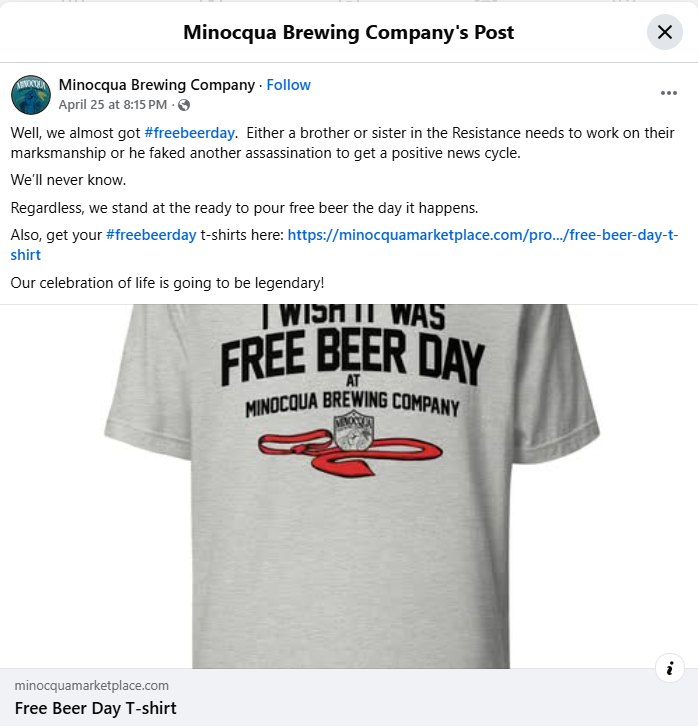
Every so often, a moment comes along that forces us to stop and ask a simple question: Is this really who we want to be? A recent social media post from a Wisconsin brewery did exactly that.
The business in question decided to promote a Tshirt and a hypothetical “free beer day” tied to the assassination of U.S. President Donald J. Trump. They framed it as humor. As resistance. As clever marketing. But let’s be honest: there’s nothing clever about celebrating political violence. There’s nothing witty about joking that someone’s death would be a great celebratory opportunity.
This isn’t about left or right. It’s not about which party someone supports (although it’s not hard to imagine the howls of outrage coming from the Left if a right-leaning business had pulled something like this). It’s about the baseline level of humanity we should expect from one another, and especially from businesses that claim to be part of our communities.
Political disagreements are normal. Passionate debate is healthy. Criticism of leaders is part of democracy.
But fantasizing about someone’s death? Turning a real act of violence into a punchline? That’s not political expression. That’s moral rot.
And it’s a rot we’ve seen creeping into our public life for years: the normalization of cruelty, the casual dehumanization of people we disagree with, the idea that violence is just another flavor of entertainment. When a business leans into that trend for clicks and merch sales, or to score political points, it doesn’t make them bold. It makes them part of the problem.
We can expect better. We SHOULD expect better.
We should expect businesses to understand that their words shape the communities they serve.
We should expect adults to recognize that political violence is not a joke. And just to be clear, this isn’t a First Amendment issue. It’s a basic common decency issue. People have the right to say almost anything they want, but rights don’t magically erase responsibility. Just because you can yell “fire” in a crowded theater doesn’t mean you should — and it certainly doesn’t mean there won’t be consequences for choosing to do it. We should expect all of us, regardless of ideology, to draw a bright line between spirited disagreement and celebrating harm.
Because once we start treating violence as a marketing gimmick, we’ve lost something far more important than a debate. We’ve lost our sense of shared humanity.
Decency isn’t partisan. It’s foundational. And when someone crosses that line, it’s not only fair to call it out; it’s necessary.